Sunday, November 18, 2007

Southland Tales: Almost Zeitgeist Now (Spoilers!!)


“Listen to me, as if I were Cerberus barking with all his heads at the gates of hell. I will tell you where to take it, but don't... don't open the box!:
-- Dr. G.E. Soberin from Kiss Me Deadly

“A lot o' people don't realize what's really going on. They view life as a bunch o' unconnected incidents 'n things. They don't realize that there's this, like, lattice o' coincidence that lays on top o' everything.”
-- Miller from Repo Man

“I’m here to save you. The world is coming to an end, Donnie.”
-- Frank from Donnie Darko

Richard Kelly’s Southland Tales wants to be the ultimate Ragnarok And Roll film. Southland Tales wants to be the It’s a Mad Mad Mad Mad World of Apocalyptic cinema.
The film’s huge ensemble cast and the maddening climax scream out Charles K. Feldman’s 1967 Casino Royale at times. Richard Kelly’s ambition and enthusiasm cannot be denied. Southland Tales was initially going to be a nine part interactive experience-- it was narrowed down to six parts. There is so much going on that there is the Southland Tales: The Prequel Saga graphic novel that has the first three chapters. The decision to use a graphic novel as a primer for his film was very Lucasian of Kelly. The last three parts make up the feature film: Temptation Waits, Memory Gospel and Wave of Mutilation.

The film received a very cold and harsh reception from the critics—more devastating than Vincent Gallo’s The Brown Bunny. The film was booed there. He is in very good company-- Sofia Coppola, Michelangelo Antonini and Robert Bresson have been booed there in the past.. Kelly cut the film’s original running time from 160 minutes to 144 minutes. I wonder in cutting the running time if some ideas got lost in the process, or maybe the film never did have steady flow. Think of Southland Tales as a more entertaining version of the 2003 film, Masked And Anonymous. The sad news is that Southland Tales is not in the same league with his previous film, Donnie Darko. It is obvious in both films that Mr. Kelly is obsessed with the end of the world. He cannot help reminding us via Justin Timberlake’s Private Pilot Abilene’s voice over narration that “This is the way the world ends, not with a whimper, but with a bang.”

Mr. Kelly uses the lines from T.S. Eliot’s poem, The Hollow Men. He uses them throughout the film and distorts them to set the mood of a wartime landscape America in 2008-- the all too near future. His premise works best as an alternate America. The film opens with quite a bang-- home video footage of a nuclear attack in Texas on the Fourth of July Holiday in 2005. Right after we see the mushroom cloud, Abilene’s voiceover narration kicks in to full gear. We learn that America is at war not only with Iraq and Afghanistan, but now we are fighting Iran, North Korea and Syria. The Draft has been reinstated; the government has taken control of the internet via US-IDENT; National ID cards exist; and the whole country is in an Orwellian nightmare. Richard Kelly goes so far down the rabbit hole it threatens to engulf the entire film. The film uses a wide array of newscasts and internet feeds to inform us of the current events of film. Think Strange Days, Brazil, Blade Runner, Twelve Monkeys, Robocop and any other dystopian film you want to throw in there. Kelly seems to have been influenced by the works of Philip K. Dick, James Morrow, Steve Erickson and William Gibson as well. The inspiration from Philip K. Dick is complete as police officer, Bart Bookman (Jon Lovitz) utters “Flow my tears.”
Timberlake’s Abilene voice narration serves to guide us throw this hybrid of genres and plots. The voice narration was inspired by Willard’s voiceover narration in Apocalypse Now. Kurtz read from The Hollow Men in that film too. Abilene’s narration reminds me of the narration from Paul Thomas Anderson’s Magnolia more than Apocalypse Now. Because of its Los Angeles setting, the film begs to be in league with Magnolia and Short Cuts.

At its heart, Southland Tales is a satire-- Richard Kelly’s dystopian rift of post-9/11 America. It is funny, chaotic, infuriating, uneven, sloppy, and has a few moments of sheer genius. It has a little bit of everything in it. If you think you see another film or book in here, chances are you are right. Robert Aldrich’s Kiss Me Deadly and Alex Cox’s Repo Man haunt the whole film. I mention these two films because the director is paying homage to both of them throughout. Richard Kelly has stated that Kiss Me Deadly, Pulp Fiction, Doctor Strangelove, and Brazil influenced his film. But watching it, I could not get over how much of an impression Kiss Me Deadly made on him. Repo Man And Pulp Fiction just paid homage to Kiss Me Deadly, but Kelly uses the Aldrich film as a blueprint for a third of his film. Robert Rodriguez and Quentin Tarantino’s Grindhouse and Richard Kelly’s new film, 2007 may be the ultimate year in self-indulgent cinema. I do not think this is a bad thing in either case, but it will alienate a lot of the audience. It also seems that Kelly is in a race with Tarantino to pay as much homage as possible to all the films that have influenced him. Dwayne “The Rock” Johnson’s Boxer Santaros is channeling Ralph Meeker’s Mike Hammer through most of the film. If it not Meeker’s Hammer then it is Laurence Harvey’s Raymond Shaw from the original The Manchurian Candidate. This does not surprise me at all-- Richard Kelly wrote the screenplay for Domino that was based on Harvey’s daughter, Domino Harvey. The other touch that comes to mind is the name of Curtis Armstrong’s character in the film, Dr. Soberin Exx. That comes directly from the Aldrich film as well. As far as Repo Man is concerned, the last twenty minutes of the film owe a lot to the end of the Alex Cox film.

Speaking of Dwayne Johnson, he is the real standout in this cast of characters. In fact, when Kelly stays on his story, the film has a real kinetic flow. When Boxer is off-screen, I am afraid the film gets lost in its own pop mythology. The film is a victim of its own ambitions which strangle and give the film several moments of cardiac arrest. What does Boxer Santaros have to do with this end of the world satire? After he has gone missing, he returns from the Nevada Desert and re-surfaces in Venice Beach, California. He suffers from amnesia; he is in the care of entrepreneurial porn star, Krysta Now, played by Sarah Michelle Gellar. Gellar’s Krysta is a version of Jenna Jameson. On paper this must have appeared as a great idea. I want to say that his commentary on the mainstreaming of pornography is novel, but there is nothing shocking or original in that department anymore. In fact, that part of the film makes perfect sense. We live in an era where Jenna Jameson is a household name. Krysta is branching out with a music career, a sports drink and has her own daily talk show which discusses a range of topics from terrorism to teenage horniness. Boxer and Krysta have written a screenplay with apocalyptic overtones that shadow the events in the film. It is here where Mr. Kelly’s original intent of making a satire of Hollywood and life in Los Angeles shine. Both of them are trying to pitch their screenplay, but everyone wants Boxer. He is a former action movie star who has ties to the Republican Party. His wife, Madeline Frost Santaros (Mandy Moore) is the daughter of Senator Bobby Frost (Holmes Osborne). Frost is part of Eliot/Frost Republican Presidential ticket for the 2008 election. Yes, there names refer to the poets T.S. Eliot and Robert Frost and their poetry is infused in the characters dialogue throughout the film. Miranda Richardson plays Madeline’s mother, Nana Mae Frost, who is in charge of US-IDENT. She is the big brother watching the whole country.

The rest of the cast deserves mention because it is such a peculiar ensemble cast.
Seann William Scott as the twin brothers, Roland and Robert Taverner is actually quite good in the film. As we learn more about his character, the film delves into the more science fiction aspects with time travel and the fourth dimension. Kelly is going back to Donnie Darko with this part of the film. The scenes between Scott and Johnson recall their last pairing in The Rundown. It is great to see Christopher Lambert as the arms dealer, Walter Mung, who drives an ice cream truck, Walter Mung. Past and present Saturday Night Live performers portray the Neo-Marxists who make up the rebellion in the Venice Beach area: Amy Poehler, Cheri Oteri, Jon Lovitz and Nora Dunn. The Neo Marxists want to foil the upcoming election and have plans for Boxer. John Larroquette, Curtis Armstrong, Mandy Moore, Will Sasso, Wallace Shawn, Bai Ling, Kevin Smith and many others make up the unique cast. Kevin Smith as Simon Theiry looks like a cross between Rick Rubin and Odin. The film is littered with 1980’s actors. It is a good touch. It underscores the obsession with pop culture very nicely.

I like the film’s soundtrack done by Moby. He gets the tone just right. His music is the perfect soundtrack for a Los Angles on the brink of chaos. While his score helps maintain the mood, the use of Jane’s Addiction’s Three Days is perfect near the end of the film. The song is the perfect synchronicity as the fates of the Neo-Marxists, Boxer and Will Sasso’s Fortunio Balducci converge. The film is billed as a musical and there is a song and dance number done by Justin Timberlake lip-synching to the Killers’ All These Things That I Have Done. This song and dance number could not have come sooner; the film’s manic energy ran out before this scene. It is a much needed jump start.

There is so much I have not told you about the plot. It is impossible to explain the film. At times, I feel it is like trying to explain David Lynch’s Inland Empire or Mulholland Drive. He is clearly influenced by David Lynch in some ways. I see shades of Lost Highway in Donnie Darko. There is only one David Lynch. There have been some saying that this film is Kelly’s Dune and Donnie Darko was his Eraserhead. Does this mean The Box will be his Blue Velvet? I really do not think that is the analogy I would go with right now. Having said that, I always thought Southland Tales would be the bridge between Repo Man, Strange Days, Robocop and Mulholland Drive. Having watched the film, I can honestly say that it is not the bridge I thought it would be. At its best, Southland Tales is a Richard Kelly style love/hate letter to Los Angeles. At its worst, it is stale and dated political commentary. His use of Santa Monica and Venice Beach helps keep the film grounded in a familiar, if distorted reality.

Southland Tales is a mixed bag of a film. It is as though Richard Kelly used a sketchbook of ideas rather than a finished screenplay to make his film. Was he afraid this would be his last film? Is that why the film is packed with so many thoughts and ideas? I can understand his rationale if that is the case. He would have benefited had he had a co-writer and a producer to tell him he could not do certain things. He needed a “no man” on the set. George Lucas could have used one of these too while making the Prequel trilogy. Maybe down the road, a Jerry Harvey type will emerge and release the uncut film on DVD or show it on a Z-Channel via the internet. Maybe Richard Kelly will release it himself on DVD. I have a feeling this film will have a huge cult following on DVD in the years to come. Still with all of its faults, I cannot help but admire this film’s ambition and audacity. I admire Richard Kelly’s vision. For me, it was a trip worth taking. I would gladly take it again. One viewing is simply not enough.

Tuesday, November 13, 2007

In The Valley Of Elah: Over There And Back Here (SPOILERS!!!)


“Maybe there's no such thing as heroes. Maybe there are just people like my dad. I finally came to understand why they were so uncomfortable being called heroes. Heroes are something we create, something we need.”
-- James Bradley from Flags Of Our Fathers

“And all the jarheads killing and dying, they will always be me. We are still in the desert.”
-- Anthony Swofford from Jarhead

If In The Valley Of Elah was intended to be Paul Haggis’s polemic against the Iraq War; it does not work as well as it should. I believe In The Valley Of Elah is much more. It is not meant to be seen as a polemic, regardless of what others are saying. To look at the film in such black and white terms is to dismiss it as another film of the week. It contains some of the best acting of Tommy Lee Jones’ career. In The Valley Of Elah is based on a Playboy article by Mark Boal. The film is also a remarkable improvement of Paul Haggis’ previous effort, Crash. I know the film won a best picture Oscar, but I found the film had a made for TV quality about it. The film benefited from some quality performances, but Haggis’ television roots were very evident. I like Crash, but it was over praised; a kind of Short Cuts lite. It is of no consequence because his new film is a staggering achievement brought to incredible life by Tommy Lee Jones. One can only assume that Paul Haggis paid very close attention to Clint Eastwood’s directorial style. Somehow Eastwood’s method sank in from Million Dollar Baby, Flags Of Our Fathers and Letters From Iwo Jima. I understand where the cynicism of Flags Of Our Fathers came from. I am sure that was part of Paul Haggis’ contribution to that underrated film. This is a police procedural on the surface with much deeper issues beneath.

Watching Tommy Lee Jones’ portrayal of Hank Deerfield unfold throughout the course of the film is astonishing. Tommy Lee Jones has a commanding presence, much more than he has had in the past. He is a great, but underrated actor. As an audience, we take him for granted. We sometimes miss his greater work in Cobb, Rolling Thunder, JFK, Rules Of Engagement, The Executioner’s Song, and especially his directorial debut, The Three Burials of Melquiades Estrada. He was doing great work long before The Fugitive and he has done a lot of stellar work since. He helped make the Men In Black films, The Client, Natural Born Killers and Space Cowboys very enjoyable movie going experiences. It seemed that Andrew Davis and Oliver Stone knew they were dealing with gold early on in his career. Still with all that has come before, Jones digs deep for the role of Hank Deerfield. Because Hank Deerfield owes more to the characters that George C. Scott played in such films as Hardcore and Rage. It also brings to mind Jack Lemmon in Missing and Michael Douglas in Traffic. In some ways, Jones performance recalls Philippe Noiret in The Clockmaker. I have never seen this side of Tommy Lee Jones. It is raw power unleashed. As the film progresses, Roger Deakins’ camera shows a man, father, and husband coming to terms with the effects of war on every facet of life. Deerfield does not have to say much; his face reveals everything. Jones is not channeling Scott, but rather taking those angry and distraught father figures to their logical conclusions. Paul Haggis originally wrote the part for Clint Eastwood, but Eastwood did not want to act in any more films. Tommy Lee Jones was the only logical choice.

When Hank Deerfield gets a call from Fort Rudd, New Mexico, that his son has gone AWOL. He is confused because he thinks his son, Mike is still in Iraq. It is important to note that the film takes place in November of 2004 during the Presidential election and the U.S. push into Fallujah. Hank decides to go to Fort Rudd to find out what happened. Hank is a retired military MP; he is a Vietnam Veteran who has done his service for his country. He leaves behind his worried wife, Joan, played by Susan Sarandon. When he gets down to Fort Rudd, his worst fears are realized. His son’s body is found in pieces and burned. The dismembered death is made to look like drug gang murder. His investigatory skills are above everyone else’s in the film; he knows more about crime scenes than anyone else on the police department. He is a thorn in the police and military’s side. He enlists the aid of an inexperienced police investigator, Emily Saunders played by Charlize Theron. Theron and Sarandon have small parts in this film, but they create vivid portrayals with their brief onscreen time. As Joan, Sarandon does some of her best work in years. As we learn, their other son was killed in an Army helicopter accident ten years ago. When Joan yells at Hank over the phone about losing both of her boys to the military, we feel her loss. The investigation is a tug of war between the local police and military led by Jason Patric’s Lt. Kirklander. At first, the soldiers in Mike’s company do not say much about what happened. As time goes on, the truth to seep out. We learn about Mike through a series of videos found on his cell phone; we learn about him through his fellow soldiers. As we learn about Mike, the videos and photos show us soldiers at war; they provide the vital clues about Mike’s death. There is no on/off switch. There is no time to decompress. How do we expect men and women to be in harm’s way one day and back here the next? That is one of the core issues of the film. It seems with each soldier’s tale; we get a clearer a picture of Mike Deerfield. Their stories make sense to Hank. He understands this all too well. As war veteran, he realizes it is not just this war, but all wars have this effect on the soldiers who fight them. When the ugly truth of how and why Mike was murdered comes out in a confession, Hank understands what has happened. His facial expressions during the final confession reveal the torture and fatigue of a whole nation.

The film attains a mythic stature due to its title. In The Valley Elah refers to the biblical tale of David and Goliath. It is a very fitting title. The David versus Goliath motif could refer to many things in the film: Hank’s investigation of hindered by the U.S. military, Emily’s battle with her own police department, or it could be the individual against the Goliath of the War itself. The film’s title refers to many things. Hank tells the story to Emily’s son one night. He cannot read C.S. Lewis’ The Lion, The Witch and The Wardrobe to him because he does not have the patience for it. He decides to tell this story to the boy named David. Hank decides to tell him the biblical origin of his name. It is a scene of touching simplicity which is very powerful. The story is seen as way of easing David’s fear of darkness; he sleeps with the door open so the hallway light comes in. After hearing the story, he decides he can let the door close a little bit. It is not only David who undergoes a profound change. Hank’s metamorphosis is the core of the film.
On his way to Fort Rudd, he drives by a school that has the American flag hanging upside down. This angers him and he stops at the school. He gets someone from the school to correct this problem. An upside down flag is used as a distress signal. By the film’s end, Hank sees things differently. It is a remarkable change for such a character. Dissent comes from the least likely places and people. By the film’s end, distress is the language of our times.

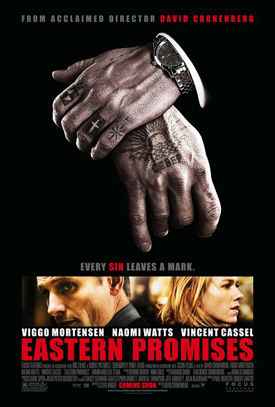
Eastern Promises: Cronenberg’s Bloody London Diary (SPOILERS!!!)


“My feelings? About ten years ago, I hid them somewhere and haven't been able to find them.”
-- Whit Sterling from Out Of The Past

“I should have killed you back in Philly.”
-- Tom Stall from A History Of Violence

“Forget any of this happened. Stay away from people like me.”
-- Nikolai Luzhin from Eastern Promises

Twenty years ago, I witnessed my first real fight. I was sixteen years old when I saw the effects of flesh pounding flesh take place. It was a party up the road from my parent’s house. The typical high school party where I first learned the rules that you deliver the goods to the crowd. I knew both boys who were fighting with each other. I had never seen real blood come from punching machines before. It left a vivid impression on me. Long after the fight had ended, after many hours of driving around, I had returned home. I told my Mom everything that had transpired earlier. For me, it was the ultimate experience of seeing bloodshed up close and personal. I must drive by that house several times a week. The impact forever sealed on my memory.

Since Spider, David Cronenberg has taken a visceral and realistic approach to bloodshed. That is not to say what came before was child’s play, but what has come after is very raw and unsettling. The Canadian director captures violence and its raw fallout like no other. This is not comic book violence. Every blow feels real to the audience.

Eastern Promises continues a winning streak for David Cronenberg. It is the third film in a row that shows us a director who has come to terms to with his raw attraction to flesh and the violence associated with that flesh. Spider was a wake up call more for us than Cronenberg. It showed a director willing to cross his own Rubicon. He might have done this with Existenz and Crash, but Spider represented a goodbye to all that. Cronenberg takes Ralph Fiennes where we have not seen him before and we are the luckier for it. Fiennes’ Spider is one of his most rewarding performances. To do this film, Red Dragon and Maid In Manhattan in the same year shows a level of range that most do not possess over a single lifetime. Spider was only a warm up for A History Of Violence-- a film based on John Wagner and Vince Locke’s 1997 graphic novel of the same name. It tackles the repressed, violent soul of Tom Stall/Joey Cusack. Who better to bring out the catharsis of American violence than Viggo Mortenson? Mortenson continues his run as Cronenberg’s visual arm in Eastern Promises. Their two films back to back prove that this director and actor work very well together. Mortenson has had such a varied career. sp far. He won immortality as Aragorn in the Lord Of The Rings trilogy and rightfully so. Before and after those films, he has had audiences fixated with his performances in A Walk On The Moon, A Perfect Murder, Witness, Crimson Tide, The Indian Runner, The Young Americans, Hidalgo, Albino Alligator and countless others. Yet, it is for David Cronenberg that he has saved his best work; Aragorn was merely a ticket to see something better and more profound. Tom Stall in A History Of Violence was only the tip of the iceberg. Eastern Promises’ Nikolai is a progressive throwback to his darker days. Mortenson’s Nikolai with his chiseled features and cheekbones recalls the Kirk Douglas of The Strange Love Of Martha Ivers and Out of The Past. Remember the days when Kirk Douglas was a bad guy. Mortenson’s Nikolai is the perfect compliment to his role from A History Of Violence. Nikolai is the Joey Cusack who never went into hiding. As with Christopher Walken, Jeremy Irons, Oliver Reed, Peter Weller, Jeff Goldblum and Ralph Fiennes, Cronenberg manages to give his leading actors some of the most memorable roles of their careers.

Eastern Promises follows the life of the Russian born, Nikolai Luzhin, a driver for one of the London’s most notorious Russian Mafia families. The family is part of the Vory V Zakone criminal brotherhood. The family is headed by Semyon, played with vicious cunning by Armin Mueller-Stahl. Semyon is the pleasant face of the Trans Siberian Restaurant in London, but beneath the surface, his Semyon is a cold and calculating monster who will do whatever it takes to stay at the top of the London underworld. This is Stahl’s most sadistic turn since his performance as the Nazi War Criminal, Mike Laszlo, in Music Box. Nikolai’s careful routine is broken when he crosses paths with Anna Khitrova (Naomi Watts). As an actress, Naomi Watts seems to possess the courage and risks that Nicole Kidman used to take. Watts’ post- King Kong career continues to show an actress taking unexpected risks. Watts’ Anna has been affected by the death of a young Russian girl who has given birth to an infant. Anna is desperate to find out the lineage of the infant girl. Her quest takes her to opposite ends of the spectrum—her Russian born Uncle Stephan (Jerzy Skolimowski) and to the Russian criminal underworld headed by Stahl’s Semyon. She finds a diary belonging to the dead girl-- a diary soaked in the blood of immigration and strife. Her uncle, Semyon and Nikolai are all active participants in the reading of the diary. Her Uncle urges her to stay away from the likes of Nikolai. Nikolai urges her to stay away from him and his kind. The diary is a powder keg that has ramifications throughout London.

Mortenson’s Nikolai is nothing we expect. He is a distant cousin of the ruthless Russian Mafia hit man, Joshua Shapira, played by Tim Roth in James Gray’s Little Odessa. Like Roth’s Shapira, Mortenson’s Nikolai makes his rounds in London while Shapira did his business in Brighton Beach, but Nikolai has so many shades to his character. For a driver, he seems to have earned the resentment and distrust of everyone around him. Who is he? He is the driver for Semyon’s family. His 47 tattoos tell a larger tale. He finds trust in Semyon’s son, Kirill played by Vincent Cassel in a career defining performance. He seems to channeling Tim Roth’s Shapira in his role as Semyon’s enforcer. The teaming up of Cassel and Mortenson is a wonderful combination. Given Cassel’s volatile work in La Haine, Brotherhood Of The Wolf, Read My Lips, Crimson Rivers and Irreversible; this is a teaming up for the ages. Kirill is a loose cannon; he is Sonny Corleone without the bravado and brotherly love. Whores and a deep resentment of his father define Kirill. He seems more loyal to Nikolai than his father. Stahl’s Semyon in some scenes comes across as Don Corleone in a much harsher tone. In one scene where he is talking down to Mina E. Mina’s Azim, one could be forgiven for thinking he is watching a stunning homage to the opening scene of The Godfather. One is almost begging to hear Semyon say:
“Bonasera... Bonasera.”


We have visited this London before. Steven Knight’s intelligent script recalls his 2003 scripted film Dirty Pretty Things. Stephen Frears was able to work his magic and bring Knight’s tale to life about the immigrant side of life in London. Cronenberg delves further into the immigrant’s tale by weaving a complex tale of the Russian criminal underworld in London. Howard Shore comes back once again to give us another unforgettable score. Shore’s sonic desires continue to compliment Cronenberg’s visions. This partnership shows no sign of winding down anytime in the near future. Eastern Promises contains one of the finest and most unique action sequences since the hammer corridor fight in Oldboy. Nikolai does battle with two Chechen hit men in a bathhouse in the nude. Nikolai has been betrayed and set up. It is the epitome of Cronenberg’s visual lust for violence. It is one of the most thrilling sequences I have seen in years. The scene alone is worth the price of admission. It is a testament to David Cronenberg’s skill and range that he still knows how to make flesh bleed in new and different ways. As with real life, we are never comfortable with the throat slashes and the other deep flesh wounds. Eastern Promises delivers!

The twist at the end, you have to take on faith!

David Fincher's Magnificent Obsession: Thoughts On Zodiac (SPOILERS!!!)


"It's to David Fincher's credit that his films take place somewhere beyond our edge-- yet in a recognizable extension of our nightmares."
-- David Thomson from The Biographical Dictionary of Film (2002)

It was with hell bent rage that I went through our house last night looking for Sharon Waxman's Rebel's On The Backlot: Six Maverick Directors and How They Conquered The Studio System. I must have searched through every room of the house. Boxes, closets and shelves examined for this elusive book. No luck, I could not find it. Even after spending 158 minutes with David Fincher's Zodiac, I still felt the need to spend some more time with him. David Fincher is one of those "rebels". This is a film about obsession and the consequences of obsession. And no I do not think Brain De Palma could do a better job with the material. The thought never even crossed my mind while watching the film. Brian De Palma is an expert at the themes on display in the film, but Fincher seems more at home than any other director. Zodiac is Fincher's beast. Robert Graysmith's book could not be in better hands. The ultimate tale of obsession told with attentive detail to every aspect of the hunt for the infamous serial killer. With this film, David Fincher proves himself to be the ultimate rebel who owns the backlot.

During the summer of 1992, I had no idea what a David Fincher film would entail. "A David Fincher film" had little or no meaning to me while watching Alien 3. The music video and commercial director had not yet registered on my map. It does seem right that a film director who cut his teeth as a technician at Industrial Light And Magic would direct the third installment of bountiful Alien franchise. Hell, he did matte work on Return Of The Jedi. It is not until the end of watching Seven that I realized we are dealing with someone with immense talent and skill. The Game is a wonderful parody of the doomed and dumb white males that Michael Douglas portrayed in films from Fatal Attraction through Disclosure. It is a maddening and suspenseful trip that never lets up. Does the film ever end? Is there any real closure? Fight Club gives us so much to think about, one wonders
how it could ever be released by a major studio. Fincher manages to craft a film that can peacefully co-exist with Chuck Palahniuk's prophetic novel. The film also reminds us that Pitt and Fincher should work together more often. The Curious Case Of Benjamin Button cannot get here fast enough. Anything would have would have been a letdown after Fight Club and Panic Room is a mixed bag at best, but Jodie Foster and Fincher are together at long last. Panic rooms were on the wish list of every executive after the film was released. An impressive body of work leads us Zodiac. After all, this is the ultimate cold case. The killer has not been found. Imagine if Kevin Spacey's John Doe in Seven had never turned himself in? Detective Mills and Somerset may never have found him. That is just a hypothetical situation. The horrifying reality of Zodiac is there is not any closure. David Fincher has made the American equivalent of Joon-ho Bong's Memories Of Murder. The truly sad thing is that David Fincher has made two astonishing contributions to the serial killer genre. I doubt he will want to do another one after such an epic undertaking. He is the only director who could bring Caleb Carr's The Alienist to the big screen and make it work.

David Fincher attacks Zodiac with a Michael Mann approach. The police procedural parts of the film echo Michael Mann's "Men at Work" ethos in such films as Heat, Thief, The Insider and Miami Vice. Fincher takes it further with this film taking it to epic heights. The scenes of the newspaper reporters and editors in the offices at The San Francisco Chronicle bring to mind Alan J. Pakula's All The President's Men. Steven Soderbergh loved the opening credit sequences of All The President's Men. David Fincher loved the actual film. Zodiac is based on Robert Graysmith's bestseller of the same name. A serial killer is terrorizing the San Francisco Bay Area during the 1960's and 1970's. The serial killer taunts the police with his letters and cryptic messages. The film is a thinly fictionalized account of the obsessive hunt for the killer. It shows in the way the characters interact with each other. The trio of Robert Downey Jr., Mark Ruffalo and Jake Gyllenhaal is one of the tightest in decades. Each actor is at the top of his game. Downey is the essence of seduction as Paul Avery, the crime reporter who is covering the Zodiac killer story. Mark Ruffalo is electric as San Francisco police Detective, Dave Toschi. He taught Steve McQueen how to wear a gun in Bullitt. And Jake Gyllenhaal is Robert Graysmith, a quiet, political cartoonist who is excellent at solving puzzles. He is the film's Boy Scout. The film belongs to each of these actors at certain points of the film. They work so well together, it is joy to watch them interact with each other throughout the film. The case consumes each of them. The hunt for the Zodiac killer is the only thing that matters. Everything else takes a backseat. Graysmith wants to be in on the chase so badly-- screw cartoons, he wants to work with Avery and find the killer. When Avery comes over and introduces himself to Graysmith, it is one of the film's warmest touches. Their evolving friendship during the first half of the film is a pleasure.

The case takes its toll on everyone involved. The never-ending chase and search for suspects. The handwriting analysis of the letters and just trying to figure out where this guy will strike next has the whole city on the edge. The film's strength is not to play it like a traditional serial killer that shows the killer going about his business. The scenes that do show the killer and his victims are indeed chilling and as an audience, we feel as helpless as the victims. It is to Fincher's credit that he never goes overboard on these parts of this film with excessive violence or gore.
“I like killing people because it is more fun than killing wild game in the forrest because man is the most dangerous anamal."
That is the first cipher from the Zodiac killer that stomped law enforcement agencies including the C.I.A. and the F.B.I., but it was decoded California schoolteacher and his wife. More letters with misspellings would continue to come over the years. The thing that is made clear is that Zodiac is an attention seeker-- a publicity whore. Is he responsible for all the crimes or is he taking responsibility for crimes he just read about in the papers? Who he is? Did they ever have a solid lead? Did the police make a mistake early on by claiming he was African American? During a screening of Dirty Harry at a local movie theater, Toschi has to walk out of the movie. He is frustrated that they are not even close to finding the killer. The man who taught McQueen how to wear a gun is disgusted because Eastwood can kill the Zodiac on the other side of the screen. On this side of the screen, that kind closure does not exist.

If the film belongs to Downey and Ruffalo at certain times, than the third act belong to Jake Gyllenhaal. As the years go by and the case and story go nowhere, Avery has been let go. His wild life of drinking and drugs has taken its toll. The case has taken its toll on Toschi and his partner, William Armstrong played by Anthony Edwards. The case costs them their partnership. Graysmith has been consumed by the case. His first date with Melanie played by Chloe Sevigny turns into all about the Zodiac. Their marriage over the years falls apart due to his obsession with the killer. He loses his job and to him his only job is the Zodiac. It is his only reason for living. Out of the whole ordeal, he was able to write two bestselling books about the case-- Zodiac and Zodiac Unmasked.
Three lives altered and weakened by the cost of obsession.

The marvel of the film is how Fincher and his cinematographer, Harris Savides not only take us back to the 1970's San Francisco, but at how they make us forget about the world we live in today. We are so used to our technology like cell phones, computers, the internet and 24 hour cable news. The film takes place long before any of this is around. It is the pre. pre-internet era. The mail and the simple telephone are the only tools they had to work with back then. The genius of the film is making us forget they we better technology today. The film transports us back to a different time with no problem. Savides shoots the film in beautiful high definition digital. San Francisco has never looked more beautiful. The rest of the cast is excellent. Dermot Mulroney is great as Captain Marty Lee. Philip Baker Hall is great as Sherwood Morrill, the handwriting expert. Brain Cox is a delight as Melvin Belli. Elias Koteas, Donal Logue and James Legros are great as the other police officers from surrounding areas. And John Carroll Lynch is down right creepy as Arthur Leigh Allen. The less said about him, the better.


As with my review for Darren Aronofsky’s The Fountain, I have written a very passionate review of Fincher and his film. I do not apologize for either review. A lot of filmmakers are my heroes. When they triumph, it is a reason to celebrate and hope that the MBA studio chief does not call the shots. When they fail and disappoint it can be heartbreaking. Watching Steven Soderbergh’s The Good German was not a happy affair. It was a hard review to write, but at least Thomas Newman did a great job with the soundtrack. David Fincher has created an epic film about the hunt for a serial killer. An obsessive quest with staggering results for everyone involved. A film that has some meaning for us today. A film about an unseen enemy. An enemy that cannot be found and strikes out without warning. A film that say more about the times we live in right now. Fincher has made the perfect film for the post 9/11 era.

Into The Wild: The Great Wide Open (Spoilers!!!)


“Wandering around our America has changed me more than I thought. I am not me any more. At least I'm not the same me I was.”
-- Ernesto Guevara de la Serna from The Motorcycle Diaries

“I mean, it's real hard to be free when you are bought and sold in the marketplace.”
-- George Hanson from Easy Rider

“If you want something in life, reach out and grab it.”
-- Christopher McCandless from Into The Wild

It is very fitting that Sean Penn’s adaptation of Jon Krakauer’s non-fiction bestseller, Into The Wild, is being released on the Fiftieth Anniversary of the publication of Jack Kerouac’s On The Road. Sean Penn has created one of the most vivid cinematic journeys of self discovery about American open road. Into The Wild has a Kerouacian undercurrent. How can it not? Christopher McCandless seems to have a little of Dean Moriarty and Sal Paradise in him. It is to Sean Penn’s credit as a director that he never gives McCandless a deliberate Beat imitation. The film is not the work of a hack trying to rip off what has come before him-- not at all. The film feels as fresh and alive as anything to come out in recent American cinema. Into The Wild has the discovery urge of Walter Salles’ The Motorcycle Diaries, the naturalistic beauty of Jean Jacques Annaud The Bear and the fatalistic charm of Werner Herzog’s Grizzly Man.

McCandless never feels like a carbon copy of someone else. Through Sean Penn’s direction, Emile Hirsch gives him a contagious curiosity that spreads to the audience. We are eager to see where his journey takes him next. With each new chapter, we wait to see what will unfold for our reckless hero.

Emile Hirsch has given splendid performances in other films-- The Dangerous Lives Of Altar Boys, The Emperor’s Club, Alpha Dog, Imaginary Heroes and The Lords Of Dogtown benefited from his presence. He tried too hard to be Tom Cruise in the Risky Business clone; The Girl Next Door, but it as Christopher McCandless where everything comes together-- a career defining moment. It is here where Sean Penn’s directing talent shines. He has always been a gifted and talented actor. There was never any doubt about his range. Yet with his directorial debut, The Indian Runner (1992), another side was shown. David Morse, Charles Bronson, Viggo Mortenson and Dennis Hopper benefited greatly from Mr. Penn’s direction. In The Crossing Guard and The Pledge, Jack Nicholson played characters he used to play in such films as The Last Detail and The King Of Marvin Gardens. Sean Penn, the director, wants to give his actors the deepest and most meaningful performances of their careers. As a result, his work has only gotten better.

We travel from box to box. We leave our homes to spend our days in another confinement. Christopher McCandless possesses a Bukowskian rage against the standard American Dream-- perhaps his is an extreme redesign of the American Dream. He wants to get back to back to nature-- following the words of Jack London, Henry David Thoreau, Leo Tolstoy and the other great writers he discovered during his college education. When he graduates from college in 1990, he wants to say goodbye to routine life. The impulse to rebel is evident from the earliest moments after his graduation from Emory University in 1990. He wants to rip apart from his middle class existence. At a graduation dinner, his parents, Walt (William Hurt) and Billie (Marcia Gay Harden) offer to buy him a new car. He rejects this gift as soon as it offered. We see that there has always been tension between father and son. Chris has other notions at hand. He gives his parents the bait of attending Harvard Law School. They buy and this gives him time to go on his great adventure into the great vast American Wilderness. Christopher was not meant to get a law degree or an MBA. He is an adventurer at heart. He has played the game for too long. He has done everything that is expected of him. Now is the time for him to live.

Sean Penn tells the film in a series of flashbacks. The film’s narrative is broken, but not in the usual way of Alejandro González Iñárritu films. Sean Penn begins at the end, but giving us a vivid series of flashbacks which never confuse us. Christopher’s sister, Carine (Jena Malone), provides a very useful voice over narration. Through her, we get a sense of what Christopher is going through and the effect it has at home on her family. What we learn from her narration is at times shocking and ultimately fills in the keys of this man’s life. As Carine, Jena Malone does not have the same amount of screen time as in Donnie Darko, The Dangerous Lives Of Altar Boys, Saved! and The United States Of Leland, but her contribution is just as powerful. The film is divided into chapters and has the words of Christopher’s letters to his friends appear across the screen in bright yellow capital letters. Once Chris has left his old world behind, he adopts the pseudonym, Alexander Supertramp. This is the point of no return; he rejects material possessions and human attachments. He sends the remainder of his college fund money to a charity and burns the money he has. Alexander is on the road to his paradise-- his great Alaskan Adventure.

Alexander Supertramp’s two year journey takes him across the country and finally to Alaska. His journey takes him from South Dakota to Southern California to the Sea Of Cortez and then to his final destination. He meets a variety of people along the way. They shape his life, but in many ways he shapes their lives as well. Everyone who encounters Alexander/Christopher seems a better person at the end of their encounters. His rejection of his parents and their way of life leads him to seek out parental surrogates. His parent’s troubled marriage convinced him to seek something different. A traveling hippie couple, Jan (Catherine Keener) and Rainey (Brian Dierker), act as his parents on the road. Vince Vaughn’s Wayne Westerberg seems like the wild uncle he never had and Hal Holbrook’s Ron Franz is a grandfather figure to him in the film’s final chapter. The scenes with Ron are very touching-- some of Hal Holbrook’s best work in recent memory. His friendship with Kristin Stewart’s Tracy is interesting. He meets her in the Slab City section of the film where he reunites with Jan and Rainey. She is quickly enamored with him, but he is such a solitary creature. She is the most available girl in recent memory, but he does not think it is a good idea. Instead, they perform a duet at night. She is an accomplished musician with the guitar. He plays the keyboards. Each of these characters and their segments demonstrate Christopher’s humanism, free spirit nature and his let the chips fall where they may attitude. It is the antithesis of what his life would have been had he not gone on the road. It is this carefree attitude that will be his undoing in the end in the Alaskan Wilderness. His lust for adventure, his risk taking and his fresh outlook on life spoke very deeply to this viewer.

We know what is coming throughout the film; his demise is a staggering and tragic ordeal. His recklessness will lead to his end. It must happen, but we do not want it happen. Hirsch has inhabited and created a vivid character. A real life persona who seemed to have a little bit of Jack Kerouac, Jack London, Ernesto Guevara and other free spirits within him. Eric Gautier’s camerawork makes everything look beautiful. Alaska is as majestic, mysterious and dangerous as Christopher has anticipated. Eddie Vedder’s songs are a welcomed addition to an already blissful soundtrack. We are not the only ones who like him; Sean Penn’s admires this character greatly. Who knows? He might have played this part many years ago. Penn’s film has an uncompromising magnificence. McCandless lived his life his way. The same can be said for Sean Penn and the films he has directed and his activism outside film. The director and the material are a perfect fit. This goes beyond anything he has ever done before. Into The Wild is one of the great American road films of our time. This is a journey worth taking.

Control: Heart of Manchester’s Darkness (SPOILERS!!!)


“I watched a snail crawl along the edge of a straight razor. That's my dream. That's my nightmare. Crawling, slithering, along the edge of a straight... razor... and surviving.”
-- Colonel Walter E. Kurtz from Apocalypse Now

“Most of all, I love Manchester. The crumbling warehouses, the railway arches, the cheap abundant drugs. That's what did it in the end. Not the money, not the music, not even the guns.”
-- Tony Wilson from 24 Hour Party People

Anton Corbijn strips away the mythology behind Ian Curtis and Joy Division to make one of the most engrossing and possibly best films of the year. Control is a triumph on every level. It won the Camera d'Or at the Cannes Film Festival this year. The film is based on Deborah Curtis’ autobiography, Touching From A Distance. To be very honest, I have never seen anything like it. This is a very different kind of band biopic-- the antithesis of films like Ray and Walk The Line. This is not Oliver Stone’s The Doors-- a fine film, but a film that says more about the mythology of Oliver Stone. The film differs from Alex Cox’s brilliant, but morbid Sid And Nancy. Some will want to rush out and compare it to Gus Van Sant’s Last Days, but I would advise against it. Last Days was inspired by Kurt Cobain’s life; Michael Pitt’s Blake is an interesting take on that life, but the film has very little life in it. Control on the other hand, has so much vitality in it. While it may not possess the manic energy of Michael Winterbottom’s 24 Hour Party People, it possesses its own kinetic flow. 24 Hour Party People was a tour de force for Steve Coogan. Coogan’s Tony Wilson is the life of the party. Manchester and the Factory Records scene of the 1970’s through the early 1990’s are portrayed with the excitement of the era. Control traces Curtis’ life from age seventeen to his suicide on May 18th, 1980 at the age of 23.

The main reason Control works so well is because it gives us a fully fleshed out portrait of a troubled human being. Sam Riley gives a career defining performance as Ian Curtis. Forget the fact that he has an eerie resemblance to Curtis, he becomes Curtis. I have only seen Riley as Mark E. Smith in 24 Hour Party People, but he leaves a vivid impression as Curtis. To say it is stunning is not fair; there are no words I know of to describe Riley’s portrayal in the film. It has to be seen to be believed. Riley plays Curtis as a very tortured soul. He is of two worlds. There is the domestic life which he so wants to keep, but then there is the band life. The film opens in 1974 when Ian is seventeen years old. He lives in a tower block of flats in Macclesfield with his parents. He writes poetry and works part time in a record store. His poetry will lead him to date his best friend’s girlfriend, Debbie Woodruff (Samantha Morton). They grow fond of each other and marry. It is at a Sex Pistols concert in 1976 where Ian will meet the members of the Stiff Kittens. They are having problems with their lead singer; Ian convinces them that he should be their lead singer. The new band is called Warsaw which transforms into Joy Division. The rest, as they say, is history.

It is Ian’s marriage to Deborah that serves as the core of the film. There is no doubt that he loves Deborah very much and wants to be a devoted family man. When Deborah becomes pregnant, he has a civil service job that he keeps while he is the lead singer for the band. One day as he is interviewing a job applicant, she has an epileptic fit. His witnessing this fit leads him to write the lyrics for “She’s Lost Control.” This serves as a foreshadowing of his life. He will be diagnosed with epilepsy and have seizures. He will be put on medications that will make him drowsy and tired. His late nights touring with the band will not help improve health. The illness is another thorn in his side. While he wants to be a good husband and father, married life does not seem to suit him. He locks himself in his room to write poetry and lyrics. He keeps Deborah and the band separate. Morton gives one of her deepest and moving performances as Deborah Curtis. Samantha Morton has not been this good since In America, Enduring Love and Morvern Callar. Her Deborah is shut out of the band’s existence just as Diane Keaton’s Kay Adams was shut out Michael Corleone’s business in the Godfather films. It is as though Ian could never reconcile the two worlds; he could never find the right balance. When the infamous Tony Wilson (Craig Parkinson) tells Ian what a great man he is, Ian cannot agree with him. He thinks less of himself. He does not think of himself as a great father to his daughter. At a gig in London, Curtis meets Annik Honore (Alexandra Maria Lara), who wishes to interview him for a Belgian fanzine. He will have an affair with her. This acts as a powder keg to his already fragile life.

It is no accident that Curtis is blown away by Marlon Brando’s performance in Apocalypse Now. Ian is moved by Brando’s portrayal of Kurtz in the film. When Kurtz recites Eliot’s The Hollow Men, Curtis is very moved. It makes sense to the audience watching Riley’s performance. His Curtis is very much like Kurtz and Corbijn has given us some Kurtz like moments throughout the film. Early on, we see the books that inspire Curtis and his songs for Joy Division. We see J.G. Ballard titles on his bookshelf in his parent’s home. This reminded me of the scene in Apocalypse Now where we see the books in Kurtz’s library-- Goethe, the Bible, From Ritual To Romance, The Golden Bough and The Collected Poems of T.S. Eliot. I could not help but make this connection early in the film. Manchester and Macclesfield serve as substitutes for the Belgian Congo and Southeast Asia. His poetry shares some of Kurtz’s intensity from the film and from Joseph Conrad’s Heart of Darkness. The decision to shoot the film in black and white highlights the terminal grayness of the local atmosphere. It was a great way to express Joy Division’s feeling and the mood of the times. Do the film’s final frames show the only way to truly escape the bleakness?

Something should be said about some of the supporting performances. Craig Parkinson does a very good as Tony Wilson. It is hard to follow in Steve Coogan’s footsteps and Parkinson never tries to top Coogan. Parkinson’s Wilson is just right. It is a pleasure to watch him interact with the band. Toby Kebbell steals most of the scenes he is in as the band’s manager, Rob Gretton. Paddy Considine played him in 24 Hour Party People. Kebbell is very funny as he swears throughout the whole film. The film serves as an excellent counterpart to Michael Winterbottom’s film.


Anton Corbijn was the right person to make this film. Control is his feature film debut. He is a very accomplished still photographer who photographed the bands U2 and R.E.M. He has directed videos for Nirvana, Metallica and Depeche Mode. He has been a devout Joy Division fan since their early days. As a fan, he has made a very user friendly film. Before 24 Hour Party People, I was a casual Joy Division fan, but that wonderful film opened my eyes up to the whole music scene of that era. It made me dig deeper than ever. In high school, one group of friends who adored the band and the music of that era. I was too busy listening to all types of heavy metal, but later in life I finally understood. This film is a stunning testament to the era. The film’s soundtrack sparkles with Joy Division and other bands of the times. You do not have to be a fan to enjoy it; you will be moved by the story and the performances. Corbijn has made their story accessible to all and it is a far deeper film than I could have ever imagined. If you are not a fan before you see the film; you may be one after watching it. Few films live up to their hype, but Control easily lives up to it! From now on, an Anton Corbijn film will be an event.

The Assassination Of Jesse James By The Coward Robert Ford: The Cult Of Celebrity Never Dies (SPOILERS!!!!)


“I always thought it would be better, to be a fake somebody... than a real nobody.”
-- Tom Ripley from The Talented Mr. Ripley

“Can’t figure you out. Do you want to be like me or you want to be me.”
-- Jesse James from The Assassination Of Jesse James By The Coward Robert Ford

On the surface, The Assassination Of Jesse James By The Coward Robert Ford looks to be another bid to resurrect the Western genre. I think it is safe to say that James Mangold’s solid remake of 3:10 To Yuma has done that job. Actually, the Western got revived by the wonderful Australian film, The Proposition, back in 2005. John Hillcoat’s 19th Century Outback film proved that Peckinpah and Leone’s Western spirits are very much alive in the 21st Century. There have been several wonderful films made about the James Gang such as Samuel Fuller’s I Shot Jesse James, Philip Kaufman’s The Great Northfield Minnesota Raid, Walter Hill’s The Long Riders and several others. Walter Hill’s The Long Riders remains one of my favorite versions of the Jesse James myth. It remains the definitive Walter Hill film. As far as westerns are concerned, Andrew Dominik’s The Assassination Of Jesse James By The Coward Robert Ford is more along the lines of Robert Altman’s McCabe And Mrs. Miller. The film has a Terrance Malick beauty about it. This comes as no surprise as I learned that Mr. Dominik was a second unit director on Terrence Malick’s The New World. Expert cinematographer, Roger Deakins, shoots this film and it shows. It may be the most beautiful looking film of the year. Nick Cave and Warren Ellis contribute a haunting score that captures the paranoia and the intensity that was Jesse James life.

Mr. Dominik’s previous film was Chopper with Eric Bana. He played Mark "Chopper" Read, a legendary criminal in Australia. If you are familiar with Chopper, Dominik’s take on Jesse James makes perfect sense. Brad Pitt’s portrayal of Jesse James makes even more sense in this light. Dominik has done a wonderful job adapting Ron Hansen’s novel to the screen. It is a maddening and uneasy film to watch at times. At 160 minutes, the film does veer off track, but when it focuses on the two main characters, it works as an excellent character study. This is far more than an art house western. I am not sure if western is the right term. The film owes more to The Talented Mr. Ripley, Misery, Single White Female and Persona than any films in the Western genre. Why those films? The relationship between Pitt’s Jesse James and Casey Affleck’s Robert Ford reminds me of the characters and relationships from those films. The film is perfect for our times as it uses the celebrity of Jesse James to study fame and idol worship. It is a timeless indictment of our celebrity obsessed culture. Our obsession with celebrity comes under Dominik’s microscope. The film’s treatment of the allure of criminals gives it a touch of the gangster genre.

The film takes place during the last days of Jesse James. Jesse James is played by Bard Pitt. Yes, Brad Pitt was one of the bright spots of last year’s Babel. But as Jesse James, this is a side of Brad Pitt we have not seen in a long time. We saw glimpses of this side of Pitt in Fight Club and Twelve Monkeys, but you would have to go back to the 1993 film, Kalifornia to see this Brad Pitt-- the crazed serial killer, Early Grayce. Whenever Pitt is onscreen, it is something to behold. His Jesse James is psychotic, paranoid, spiritual, intelligent and charismatic. We see his full range of brutality early in the film during one of the gang’s last train robberies. As the infamous outlaw in the film, he wants to plan new robberies, contend with a bounty on his head and worry about betrayals within his own gang. It is a tour de force performance from the actor. Whenever we want to admire the outlaw, he gives the audience reminders to be frightened of him when we least expect it. This is one of Brad Pitt’s best performances since Twelve Monkeys. He deserved the best actor award at this year’s Venice Film Festival.

Dominik does romanticize Jesse James early on. In some ways he has to for the character of Robert Ford to work at all. Robert Ford is played by Casey Affleck. Affleck’s Robert Ford is a cross between Matt Damon’s Tom Ripley from The Talented Mr. Ripley, Andy Serkis’ Gollum from The Lord of the Rings Trilogy, Kathy Bates Annie Wilkes from Misery covered in a Judas Iscariot wrapping. As Robert Ford, Casey Affleck is at his pathetic best. Robert Ford is the ultimate fan. He wants nothing more than to join his brother, Charley (Sam Rockwell) and ride with the James’ Gang. He has been collecting nickel books and newspaper clippings about Jesse James his whole life. This is Robert’s ultimate goal in life. In the beginning of the film, he is interviewed by Frank James played Sam Shepard. I did not get the impression Frank was too keen on having him join the gang. He senses something is not right with the boy. Robert Ford idolizes Jesse James. He eventually ingratiates himself into the gang. It helps to have an inside track. It seems eerily appropriate that Brad Pitt plays the idolized bandit. Brad Pitt knows a thing or two about fame, stalkers and the trappings of celebrity. The third act of the film belongs to Casey Affleck. He creates an uncomfortable persona. His wretched desire to become famous contaminates his very essence. His Robert Ford possesses the same kind of mentality of Matt Damon’s Ripley in The Talented Mr. Ripley. He seems uncomfortable in his own skin. He starts to see Jesse James for who he really is; he thinks by killing Jesse James, he will be treated as a hero, but there will be no applause for him. Robert Ford comes across as the greatest traitor since Judas. Robert Ford’s life will be as hollow as ever.

The film has some fine supporting performances. The one thing I can say is that Mary-Louise Parker has a thankless role as Zee James, Jesse’s wife. She does not have much to do. Maybe the success of Weeds will give her better roles, but one can understand why she accepted the part in this prestige project. The always reliable Zooey Deschanel plays Dorothy Evans, but she is hardly in the film. Sam Rockwell continues his winning streak as Charley Ford. He has great chemistry with Affleck’s Robert. San Shepard is very good as Frank James. One could say that when he exits the film, the classical Western elements leave with him. The film becomes darker giving way to a last day’s mentality. Still, the film comes to life whenever Casey Affleck and Brad Pitt are onscreen. It is an intense character study. It is an absolute blast to watch Pitt and Affleck interact with each other. The mythology of heroism comes undone as we watch these two characters do their dance-- one turning into his constellation and the other becoming dust.

Andrew Dominik has directed a film for our times. In an age of intense and hyper news cycles, the public has an insatiable thirst for all things celebrity. We cannot get enough of it. Every form of media caters to the celebrity whirlwind. One can only imagine how many friends Jesse James would have on his MySpace page. Robert Ford would probably make a fool of himself on YouTube. Robert Ford’s obsession with Jesse James is the ultimate case of hero worship gone badly. The beauty of Dominik’s film is that nothing really changes. We are obsessed with fame.

Add This

Bookmark and Share

RSS Feed

AddThis Feed Button