Tuesday, November 13, 2007

Reservation Road: Prolonged Reckonings (Spoilers!!!)


“I just feel lost, Frankie. You know? I just, um... I just feel lost.”
-- Kathy from House of Sand and Fog

“Sometimes things happen that are out of your control and those are the times you have to stand up and be a man.”
-- Dwight Arno from Reservation Road


One evening, in a horrific second, the lives of the Learner family are changed forever. Their son, Josh Learner (Sean Curley), is killed by a hit and run driver outside a gas station on Reservation road. The family has just come from a music recital where Josh has played the cello beautifully-- an incredibly gifted musician. They stop at a gas station. While his parents, Ethan (Joaquin Phoenix), Grace (Jennifer Connelly) and sister Emma (Elle Fanning) go inside the station, he remains outside to release fireflies from a jar. Meanwhile, Dwight Arno (Mark Ruffalo) and his son, Lucas (Eddie Alderson) are coming home from a Boston Red Sox game. They had a great day at the game. Lucas is exhausted from the excitement of the game. Dwight is cruising along; and he is distracted by his cell phone. His son is sleeping on the passenger side. In a matter of seconds, he swerves to avoid another car, but in doing so he hits Josh. Dwight knows he has hit and possibly killed the boy, but he panics and keeps driving. The Learner family has lost their son. Ethan has witnessed the accident, but all he knows is that a black SUV is responsible for taking his son away from him. Dwight tells Lucas, they hit a log. Each father will deal with this in his own way.

Terry George’s Reservation Road attempts to be a film in the same league as recent, great American dramas like We Don’t Live Here Anymore, House of Sand and Fog and Little Children. Sadly, the film never rises to the level of those films. It has all the tragic elements that made House of Sand and Fog one of the great tragedies of recent American cinema, but it falls short in the end. Terry George is a very accomplished director. Some Mother’s Son and Hotel Rwanda are stellar films. Yet, he and screenwriter, John Burnham Schwartz, adapting from Schwartz’s novel, seem to miss the mark. I am not sure why it does not come together, but the film is saved by some wonderful acting. Mark Ruffalo, Joaquin Phoenix and Jennifer Connelly manage to give their characters incredible life. Without them, this would be another television movie of the week. These three actors give the film its pedigree. Yes, it desperately smells of Oscar nomination, so much, that I am afraid it hurts the film at times. The coincidences of the film sometimes feel forced, but maybe that is the point. The coincidences move the film along and create an uneasy feeling. Perhaps, they should try to create the tension needed to give the film a pulse. Still, it is the acting that rises to the occasion.

Mark Ruffalo’s Dwight is problematic. While Ruffalo brings all his talent to the role, Dwight brings all of this on himself. He digs himself deeper and deeper into a hole. Why did he run? He panicked and by doing this, he has set himself on a downward spiral. As police are canvassing the area for a black SUV, he parks his in the garage and gets a rental car. Dwight Arno just wants to spend time with his son. He is divorced from his wife, Ruth Wheldon, an underused Mira Sorvino. He cherishes the time he has with his son. On the night of the accident, he brings Lucas home with a bump on his head which infuriates his ex-wife. Their marriage was a disaster. Dwight has ample opportunities to turn himself in, but he does not. The ironic reason for his not coming forward is that he wants to spend time with his son. Things only get worse. Ethan Learner, fed up with the police investigation, goes and hires a law firm to help with the case. Dwight is an attorney at the firm and he is put in charge of the case. I want to say that Dwight is a canard as a character. He should know better; his rationale for prolonging the anguish does not work. Ethan lost a son and Dwight must in the end lose time with his son. Will he do the right thing? Ruffalo is always good, but it is not enough in this case. Ever since, You Can Count On Me, he has delivered a string of powerful performances. I am baffled by his Dwight. I really want to hate him. He is a despicable character in the film. Ruffalo may be too likable for the part. The verdict on Dwight rests with how he handles himself with the inevitable showdown with Ethan.

Last week, Joaquin Phoenix walked away with We Own the Night. As Ethan Learner, he delivers a different kind of intensity. A college professor, he is overcome with grief and yearns for revenge; Phoenix delivers an intense study in the anger brewing up inside. In many ways, Ethan Learner is metaphor for America in the post-9/11 landscape. Why did this happen? How does one deal with it? He wants to lash out at someone. He wants justice, but he is not getting it from the local police. Most hit and run cases are never solved as he finds out. He goes online and finds an online community of victims’ families. This was a nice touch, but many critics have a problem with the use of the internet in place of intimate telephone conversations. It is a routine, everyday activity. I welcome the use of Google, chat rooms and instant messaging in a film as long as it helps move the plot. In this case, it does and it helps show what is going through Ethan’s mind. His interaction with other parents in the same situation is vital to the story. He goes around photographing all of the black SUV’s that have damage to the front. He does this in front of a Saudi diplomat’s house and this gets him into trouble with the Connecticut police who are trying to help him. His obsession with finding the killer is tearing his family apart. His wife, Grace, wants to move on with their lives. Leave it to Jennifer Connelly to be the wise one. In such films as Little Children, House of Sand and Fog, Waking The Dead and Requiem For A Dream, she has become the first lady of American drama. She shines as Grace. She is an anchor. She is devastated just as much as Ethan, but she realizes you have to go and focus on the child that is still alive. Still, Ethan must go on his own path. He cannot rest until he confronts the person who did this to his family.

Reservation Road should work better than it does. The death of a child has a ripple effect on the two families in the film, especially the two fathers; one who has a lost a son and one who is trying not to lose his son. Dwight’s actions make sense, but to what end? Is it worth all this just to prolong the inevitable reckoning? The heightened melodrama only works in parts and not as a whole. Dwight could be forgiven for his panic at the beginning, but with each passing moment, it is very hard to even have empathy for him. He digs himself in a hole too deep. The character of Dwight Arno is one I am going to have to wrestle with for now. I am not sure what to think of him once the credits roll.

Monday, November 12, 2007

Before The Devil Knows You’re Dead: Tragic Debt (Spoilers!!)


“I'm robbing a bank because they got money here. That's why I'm robbing it”
-- Sonny from Dog Day Afternoon

“We're all doing time. Even the screws.”
-- Joe Roberts from The Hill

“I was married for four years, and pretended to be happy; and I had six years of analysis, and pretended to be sane. My husband ran off with his boyfriend, and I had an affair with my analyst, who told me I was the worst lay he'd ever had.”
-- Diana Christensen from Network


Sidney Lumet is an institution. He is timeless. He is the hardest working director out there. At the age of 83, he has made an incredible film, Before The Devil Knows You’re Dead. He has turned Kelly Masterson’s first screenplay into a powerful and tragic crime drama. Most directors slow down, but like John Huston before him and Clint Eastwood, he shows no signs of slowing down-- his career that started out in the golden age of television. He made the successful crossover into feature films. The hits include Twelve Angry Men, The Fugitive Kind, The Pawnbroker, Fail Safe, Network, Dog Day Afternoon, Serpico, The Hill, The Verdict, Running On Empty, The Prince Of The City, Q & A, Night Falls On Manhattan, and many others. He directed some of the most important films of every decade. I would be the last person to call his latest film a comeback. Find Me Guilty, while not a box office hit, showcased Vin Diesel in one of his best roles. The film was further proof that no one can make a courtroom drama as exciting as Mr. Lumet. One wonders why he bothered with a remake of John Cassavates Gloria in 1999-- Sharon Stone is no Gena Rowlands. Still, the good greatly outweigh the bad in his career.

On the surface, Before The Devil Knows You’re Dead, is a jewelry store heist gone horribly wrong. This heist film has many layers to it. The chronology of the film is told out of sequence, but the fractures only heighten the layers of storytelling. It is not done for flash, but for depth of characterization. The robbery at the heart of the film is the epitome of everything that can go wrong. So wrong, that the ripple effects reach further than anyone would ever imagine. Philip Seymour Hoffman plays, Andy, a debt ridden payroll manger at a Manhattan real estate office, who ensnares his younger brother, Hank (Ethan Hawke) into a criminal scheme-- the robbery of a suburban strip mall jewelry store. It sounds like an easy target-- all too easy. There is one problem with this whole operation. The jewelry store is owned by their parents. Andy assures Hank that nothing will go wrong. It is a “victimless” crime; the insurance will cover the loss. This is too good to be true. Things go wrong, horribly wrong. The day of the robbery is the beginning of the end. What unfolds throughout the fractured narrative is as inventive, desperate, depressing and evil as anything I have seen in many years.

The genius of Lumet’s film is that it is so much more than a simple heist gone wrong film. I would put this film right on par with Stanley Kubrick’s The Killing and John Huston’s The Asphalt Jungle. I am by no means discounting any of the fine films that have come in between these films. The Lookout, Reservoir Dogs, City On Fire, and the original version of The Getaway are all excellent films, but Lumet takes things a step further. His film is Greek Tragedy. Through the brothers, Andy and Hank we witness the disintegration of family, trust and loyalty. Hoffman’s Andy is one of the most sinister characters he has ever played. Andy is a fuller portent of evil than his Dan Mahowny in Owning Mahowny. The virulent cocktail of desperation and ruthlessness goes much further than his thuggish turn as Dean Trumbell in Punch-Drunk Love. His Oscar winning turn as Truman Capote only tempted us with the actor’s capability toward playing darker characters. Hoffman’s Andy has a nasty heroin habit that his eating into his funds. His extracurricular activities are forcing him into debt. Andy feels he is owed something from his parents. We get the impression he was jealous of Andy, who will always be the baby of the family. Andy is the antithesis of Lumet’s iconic Howard Beale, played by Peter Finch in Network. Andy is mad as hell, but his anger eats away and corrodes his spine. His inward desperation destroys everyone around him.

His younger brother, Hank, is also having trouble making ends meat. He has enough trouble paying child support for his daughter. Both brothers work at the same firm.
As Hank, Ethan Hawke delivers one of his best performances. To be honest, I have no idea why I was ever hard on him in the first place. He has done solid work off and on for many years. Training Day, Gattaca, Reality Bites, Before Sunrise, and Dead Poet’s Society featured very good performances from him, but it is his performance as Hank that he will be remembered. While he is the kinder of the two brothers, he is no saint. He is having an affair with his brother’s wife, Gina (Marisa Tomei). He employs an accomplice for the robbery which does not work out well for anyone.

The two sons live in the shadow of a truly god-like father. Albert Finney plays the family patriarch. As Charles, he towers over the boys. He is the epitome of the middle class American Dream success story. He and his wife have done very well for themselves and operate a thriving suburban mom and pop jewelry store in the suburbs. Albert Finney has never been better. It is safe to say, he has screen presence. Recent films like The Bourne Ultimatum, Big Fish, Simpatico, The Gathering Storm and Erin Brockovich reminded us why he has remained so relevant. Two For The Road, Under The Volcano, Miller’s Crossing, Tom Jones and Shoot The Moon were causes for celebration. Finney’s Charles haunts the whole film. His pull is everywhere. He put all his energy into his work to provide for his family. His sons, specifically, Andy, have used avarice and desperation to destroy all that hard work in the span of a Saturday morning. I will not give away anything else. This film needs to be experienced as a cathartic discovery for the viewer.

A crime that goes horrifically wrong underscores a modern American tragedy. Andy and Hank are not really criminals. They are a cross breed of the lowlifes who made up some of Jim Thompson’s best work and the characters that populated Lumet’s other films such as Dog Day Afternoon, Family Business or The Anderson Tapes. The two brothers are metaphors for the disintegration of the Middle class in American today. We see in them the all too real horrors of what is happening in our country right now-- the recent collapse of the housing bubble which has lead to foreclosures and bankruptcies. The film plays like a cinematic version of Paul Krugman’s bi-weekly column for the New York Times. Their actions destroy not only themselves, but their family and all of those around them. Once again, Sidney Lumet is riding the whirlwind.

No Country for Old Men: Chronic Malevolence and Avarice (Spoilers!!!)


“It's the American Dream in a goddamn gym bag!”
-- Lou Chambers from A Simple Plan

“I don't know, he ought to. He's seen the same things I've seen, and it's certainly made an impression on me.”
-- Ed Tom Bell from No Country For Old Men

Anton Chigurh is Death. Chigurh is the vicious, unstoppable psychopath at the heart of the Coen Brothers new film, No Country For Old Men. Chigurh is played to wicked perfection by Javier Bardem. He stalks the Texas border looking for a satchel containing two million dollars. Nothing and no one can come between him and the money. Chigurh is a far cry from the character Bardem played in The Sea Inside. Sadly, for his victims, Chigurh is very much mobile. Bardem’s intensity is in high gear right from the start of the film. He manages to escape the clutches of a police arrest. Once he escapes jail, no one is safe. A looming sense of dread has entered the barren and desolate landscapes of Texas in 1980. He uses a lethal nail gun to do away with his victims. Bardem is a one man reign of terror-- a specter of pure violence with a Prince Valiant haircut; coin tosses save some of his potential victims. Chigurh could put the fear of God into such cinematic monsters as Dennis Hopper’s Frank Booth, Anthony Hopkins’ Dr. Hannibal Lecter, Michael Rooker’s Henry or even Arnold Schwarzenegger’s Terminator.

Joel and Ethan Coen have brought Cormac McCarthy’s novel to vivid and stark life. This is their first literary adaptation and their style compliments Mr. McCarthy’s writing style. I dare say that the Coen Brothers have made their finest film to date. That is saying something because what has come before, for the most part, happens to be some of the most original films in American cinema. No Country For Old Men is also their darkest and most violent film to date. The film certainly belongs in the realm of such Coen Brothers masterpieces as Blood Simple, Miller’s Crossing, Barton Fink and Fargo. Veteran cinematographer, Roger Deakins, displays a Texas familiar to McCarthy’s novel and a desolation that defined many of Jim Thompson’s great crime novels. Deakins has been a longtime collaborator with the Coen Brothers. His work only adds to each film he has worked on with them. The barren landscapes are drenched in the blood of drug deals gone badly and people being in the wrong place at the wrong time. His camera shows barren faces as well as barren landscapes. The brothers also edit the film under the pseudonym, Roderick Jaynes. Their editing, like their writing and directing, represents a technique that has served them well over the years. A Coen Brothers film is a unique piece of work that one would never confuse with any other filmmakers. Longtime music collaborator, Carter Burwell returns to score the film, but in some instances the absence of the music is key to the film. Sound plays an integral part of the story. The sound of Chigurh’s nail gun weapon in use against victims and door locks is its own character. The sound of creaking floors and noises in desolate motels only heighten the stakes.

No Country For Old Men runs at a swift pace. When Texas hunter, Llewelyn Moss (Josh Brolin), discovers a small fortune at the scene of drug deal gone violently wrong, the plot is set into motion. He finds a suitcase with two million dollars in it; he also finds a large shipment of heroin. Of course, Moss takes the money and runs. It seems like the answer to all his problems. This small fortune is what Chigurh is determined to retrieve at all costs. Llewelyn’s life takes a dangerous turn for the worst once he takes the money. Sam Raimi visited this terrain with his wonderful adaptation of Scott Smith’s A Simple Plan-- greed never pays. It never works out for anyone. In that film as well as The Treasure Of Sierra Madre, it just rots the core of the soul.

2007 should be remembered as the year of Josh Brolin. Planet Terror, In The Valley Of Elah, American Gangster, and No Country For Old Men represent a major step up for the actor. I believe he is a better actor than his father. We like him as Llewelyn. We are rooting for him the whole time as he stays one step ahead of Chigurh. He decides to go back to the scene of the crime to give one of the dying men water. When he gets there he is attacked by other Mexican drug dealers. He chased and shot at. They cut loose the dogs after him. He manages to survive this harrowing ordeal. He realizes what the stakes are and is prepared to make a better life for him and his wife, Carla (Kelly Macdonald). His boldness is rewarding to the audience. We really want him to make it. We want someone to stand up against Chigurh’s insatiable wrath; we want Llewelyn to defeat death.

There is a philosophical current that runs throughout the film. The wisdom and philosophy of the film is represented by Tommy Lee Jones’ Sheriff Ed Tom Bell. Jones is perfect as Bell; he continues a string of world weary and disillusioned characters that reaches its zenith in this film. He displayed the same qualities in The Three Burials of Melquiades Estrada and In The Valley Of Elah. Sheriff Bell thought he had seen it all, but the rampage which follows the drug deal mess in the beginning of the film changes all of that. Through Bell, we understand the meaning of the title. Drugs have changed the landscape of the Texas of his youth. The changing nature of evil haunts Bell. He has never seen anything like Chigurh’s rampage. He is deeply concerned for Llewelyn and Carla. The events have left a vivid impression on Bell’s psyche. His conversations with his deputy, Wendell (Garret Dillahunt), his wife, Loretta (Tess Harper), an El Paso sheriff (Rodger Boyce) and Ellis (Barry Corbin) reveal how much things have changed. What has happened? Have the crimes gotten more violent? Has he outlived his usefulness? Has civility left the arena? It is a combination of things. Tommy Lee Jones plays Bell as a cross between Randolph Scott’ Ben Stride in Seven Men From Now and William Holden’s Pike Bishop in The Wild Bunch. He has the honor and nobility that Randolph Scott brought to each western, but there is a Peckinpah feeling of a man who has outlived his times. The film has a deliberate neo-western noir atmosphere going on about the perimeters. There is a desperation within him that reminds me so much of the characters that made up many a Peckinpah film. His mannerisms and methods remind me of Bill Paxton’s Arkansas Police Chief Dale "Hurricane" Dixon in Carl Franklin’s One False Move. It is his conversations with the El Paso sheriff that underscore those feelings. It is not like the old days. Something has changed over the years. Civility left the premises and a new order of violence and retribution has taken over the landscape.
The country has no use for their kind anymore. Men do not get to grow old and retire in these dark times. You will be lucky if you get a chance to draw your gun.

Woody Harrelson has a small part as the bounty hunter, Carson Wells. He is perfect as the person assigned to go after Chigurh. He knows all about Chigurh’s evil. He compares him to the “Bubonic Plague” to the man who hires him. He also knows that Chigurh has no sense of humor although there is a diabolical smirk that comes across his face as he issues the coin tosses. Harrelson has not been this effective since Stephen Frears’ The Hi-Lo Country. I liked him in A Scanner Darkly as well. For his brief part, he is perfect as Carson Wells. There is a sense of hope as he is brought in to deal with Death. When Wells meets Moss in a Mexican hospital, Wells is surprised that Moss survived an initial encounter with Chigurh.
“What is he, like the ultimate bad-ass…”
Moss asks Wells. Of course, Wells knows that is just a euphemism at best. Woody Harrelson was meant to work with the Coen Brothers. He, like Cormac McCarthy, is a perfect fit to their style.

Avarice is the undercurrent in the film. There is no shortage of greed at the movies in 2007. Before The Devil Knows You’re Dead, Michael Clayton and American Gangster all deal in shades of avarice and its self destructing power. This theme will only get stronger by the end of the year with Paul Thomas Anderson’s There Will be Blood. Greed never dies. Just look at what it did to characters in A Simple Plan and The Treasure Of Sierra Madre. The money that Llewelyn is carrying around will bring him nothing but death and misery. His choice sets him on a collision course with one of cinema’s most evil forces. Chigurh’s greed is far worse than Llewelyn’s in this case. Chigurh is destroying everything in his path to recover this fortune. The landscape is forever altered after Chigurh makes his way. These age old themes, a great story, great actors and wonderful direction make No Country For Old Men an instant masterpiece.

Lions For Lambs: History Repeats Itself (Spoilers!!!)


“Listen... I'm tired of your chickenshit games! I don't want hints... I need to know what you know.”
-- Bob Woodward from All The President’s Men

“You fuckin' people. You have no idea how to defend a nation. All you did was weaken a country today, Kaffee. That's all you did. You put people's lives in danger. Sweet dreams, son.”
-- Colonel Nathan R. Jessup from A Few Good Men

“Any man with a collection like this is a man who's never set foot on a battlefield.”
-- Lt. Gen. Eugene Irwin from The Last Castle

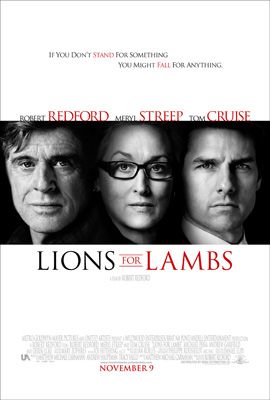
Robert Redford’s Lions For Lambs works well as an attack on the fourth estate during the War On Terror era. Lions For Lambs arrives in a season of box office disappointment for serious films dealing with heavy political and military themes. One only has to look at last month’s Rendition to realize that these films are a tough sell. The good news is that Redford’s film works a lot better than Gavin Hood’s Rendition. Rendition had the potential to be a very engaging film about the torture debate but got lost in its desire to be like last year’s Babel. At its best, Lions For Lambs is a thought provoking film that dares the audience to think about the current state of affairs of American foreign policy and how its impacts all of us. At its worst, the film is a lot of talk. Talking heads are great for Sunday morning public affairs programs, but that does not translate into great cinema. Talking heads make for excellent documentaries like No End In Sight or any number of PBS Frontline documentaries. The film’s screenwriter, Michael Matthew Carnahan also wrote The Kingdom-- a very entertaining action film that used the police procedural as a way to combat terrorism abroad. The film seemed to be saying that you should send a special team of FBI agents to fight the terrorists. The Kingdom is the only film that has fared well at the box office this season dealing with these issues. Still, it was not the hit they thought it would be.

Robert Redford and Michael Matthew Carnahan, use three loosely connected storylines to deliver a stinging attack on the media. The film has a noble goal of attacking the apathy of the nation. It helps if the rebuke comes from Robert Redford. There must be a boiling rage within him. He once played Bob Woodward in the iconic All The President’s Men. Bob Woodward used to go after people in power who were lying. What happened to him? When he did he lay down his weapons and become the Bush White House Stenographer. Finally, he changed his tune with State Of Denial back in 2006. While Woodward is never mentioned in the film, Redford uses television journalist, Janine Roth, played by Meryl Streep, as a way to deliver an assault of what went wrong with media in the build up to the Iraq War. The film works best as it explores the tense relationship between journalists and politicians. The scenes between Streep’s Roth and Tom Cruise’s rising star GOP Senator, Jasper Irving are the highlight of the film. Tom Cruise (as Irving) is perfect. Irving is a bastion of neo-conservatism and patriotism-- never once doubting the mission statement and goals of the war on terror. Cruise is convincing as Irving. Leo Strauss must have written his lines. Cruise takes all the energy from his great previous roles in Magnolia, A Few Good Men, Collateral and War Of The Worlds and creates a vivid presence onscreen. Irving gives Roth an hour to sell her a new strategy in the Afghanistan conflict. Irving has a bombshell of a story. It seems that a new front has opened in that war-- Iran is allowing militants to cross through the country from Iraq into Afghanistan. Shia and Sunnis are working together. Irving believes this is the worst case scenario. Should Roth believe him? This is where the film works. Will the press once again sell the administration’s new war plan as it did in 2003 prior to the Iraq War? Will history repeat itself?

I like what Robert Redford is doing in this part of the film. He is taking the media to task for not asking the hard questions about the Iraq War. Janine Roth is the antithesis of Irving. She still believes in her Sixties idealism. Her liberalism has never faded, but we learn through their conversation that Roth, like everyone else, went along for the ride and helped the White House sell the War to the American People. It is here that Redford’s own anger comes out. America was fooled once going to war in Vietnam. Yet the same thing happened again with the Iraq War. The question that Roth must now ask herself is can she sell this new strategy to her bosses over at the network. Will she make the same mistake again? Of all the conversations, this is the most powerful one in the film.

Robert Redford plays an idealistic college professor, Stephen Malley, at a West Coast university. Malley meets with one of his students, Todd Hayes (Andrew Garfield) to discuss many things. He wants to reach out to Todd, a privileged, but disaffected student.
We learn that Todd is very bright and very much on top of things in Malley’s class. In short, he wants Todd to do something important with his life. He sees a lot of potential in the fraternity boy. What we learn through the course of their conversation is enough to make us want to scream. It seems that Malley’s idealism influenced two of his previous students, Arian (Derek Luke) and Ernest (Michael Pena) in the wrong way.
They took the important thing to mean they should volunteer and join the military. They go to fight in Afghanistan. Malley is full of guilt and blame. This is not what he wanted from his students. I am sure this part of the film dealing with Todd will have an impact on the college students watching it. What side are you on in the post- 9/11 world? You have to stand for something and put those beliefs to action. Will his message get through to Todd?

The conversation between Todd and Malley relates directly to Arian and Ernest’s mission in Afghanistan. They embark on the beginning of the plan that Irving tells Roth about at their meeting. All three stories are connected. The connection is done more straightforward than in other films like Rendition or Babel. All three of these segments are going on within the same hour. Their Chinook helicopter is attacked by enemy fire. Arian and Ernest jump off the helicopter before it crashes. They are the only survivors. This is the weakest part of the film. That is sad because it should be one of the strongest given the incredible story of how Arian and Ernest got to this point. I guess you could say it works to an extent by showing how policy becomes action. Derek Luke and Michael Pena are very good actors. I wish they had more to do in the film for this part of the film just does not work.

Lions For Lambs is a maddening film. It could have easily been called Conversations on The War On Terror. The film asks a lot of questions. What does it mean to be patriotic? What does the truth mean? What side are you on? There is a lot of talk in the film. I cannot say that this makes for compelling cinema. Yes it is great that Robert Redford has made a message film. It is his most interesting and engaging film since Quiz Show as a director. Yet something does not add up in the end. The film does feel like a lecture and civics lesson at times. John Sayles makes these kind of films a lot better. This film is great for people who do not read a daily newspaper and do not keep up with current events. To everyone else, it is not telling them anything they did not already know. I do feel like I am watching Meet The Press or Hardball when watching parts of this film. I live in the Washington DC Metro area and have for most of my life. We live with these issues 24/7. While I admire what the film is trying to do, it cannot help but feel dated. The real life narrative is constantly changing on a daily basis. The events in Pakistan of the last week underscore this problem. No film has yet to capture the times we live in right now. I do give Lions For Lambs credit for trying.

Saturday, November 3, 2007

American Gangster: The Best And The Brightest (Spoilers!!!)


“And why? Because -- I believe this drug business -- is gonna destroy us in the years to come. I mean, it’s not like gambling or liquor -- even women – which is something that most people want nowadays, and is ah forbidden to them by the pezzonovante of the Church. Even the police departments that’ve helped us in the past with gambling and other things are gonna refuse to help us when it comes narcotics. And I believed that then and I believe that now.”
-- Don Vito Corleone from The Godfather

“See, ya are what ya are in this world. That's either one of two things: Either you're somebody, or you ain't nobody.”
-- Frank Lucas from American Gangster

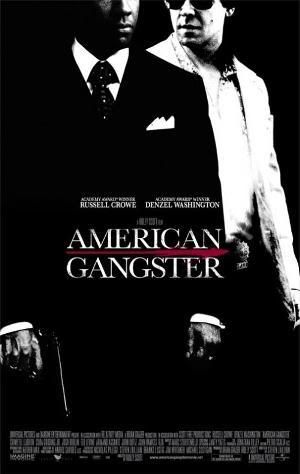
The opening scenes of Ridley Scott’s epic, American Gangster are incredibly powerful. Bumpy Johnson’s (Clarence Williams III) old time gangster ethos is perfectly captured as he is talking with his driver, Frank Lucas (Denzel Washington) about the loss of dignity and self respect with the younger generation of criminals. Bumpy was the king of everything above 125th Street by the 1960’s. He was the godfather of Harlem. Laurence Fishburne played the younger Bumpy in Bill Duke’s underrated Hoodlum. In the span of a few minutes, the power of Williams’ Bumpy is provocative and far reaching. The performance haunts the remainder of the film in a very good way. Bumpy is the film’s Vito as Frank is the film’s Michael Corleone. Bumpy is his surrogate father. He learned everything from him. When Bumpy dies of a heart attack, we can see the ambition in Frank’s eyes. When it is his turn at the helm of the Harlem crime syndicate in the late 1960’s, we know he listened very well. And like Al Pacino’s Michael Corleone, he took it upon himself to do things his own way. While there are similarities to one of the greatest stories every told, American Gangster owes it success to many things. It is based on the true story of the Harlem gangster, Frank Lucas. Steve Zaillian’s overly ambitious screenplay was originally two screenplays. He wrote one version from Frank Lucas’s point of view and another on Russell Crowe’s Richie Roberts’ point of view. The merging of these two personas brings us one of the finest crime stories in some time. Ridley Scott’s film has a little bit of everything. I see shades of Heat, Scarface (1983), The French Connection, Serpico, New Jack City, Goodfellas, The Prince Of The City, The Godfather films, Year Of The Dragon, Black Caesar, American Me and many of the great classic gangster films. The gangster genre is very much alive in the post-Sopranos era.

As Frank Lucas, Denzel Washington delivers a stunning performance of charming ruthlessness and cunning intellect. Denzel Washington is rarely boring. It is not in his nature; his charisma lends itself to every role he has taken over the years. His Oscar winning turn as the corrupt cop in Training Day was proof that he could play against type. His Alonzo Harris was one of the best arguments against typecasting since Henry Fonda’s Frank in Once Upon A Time In The West. Frank Lucas has some of Alonzo’s mean streak in him, but Washington goes further back, not just to Al Pacino’s Michael Corleone. I see in his Frank Lucas, Paul Muni’s Tony Camonte from Scarface, Edward G. Robinson’s Caesar Enrico 'Rico' Bandello from Little Caesar and James Cagney’s Tom Powers from The Public Enemy. Frank Lucas is first and foremost a businessman. He has a plan to respect the legacy of his late boss, and to also make a name for himself. Frank’s plan is genius. He has a cousin who is a well connected career military officer in Southeast Asia. Frank’s plan allows him to smuggle in pure Chinese heroin. His product is so pure, repeat business is going to be a problem down the road. The film takes place during the Vietnam War. Scott’s decision to let television news coverage of the war show the passage of time is an excellent touch. The parallels to the current war are not lost. Frank Lucas is the personification of the American Dream. He is self made. This is where he differs from Michael Corleone. Michael, like his father, never got the family into the drug business, but Frank does take this route. The Corleones remain fantasy-- the mafia did get into the drug trade. Frank rose from nothing-- coming from North Carolina to eventually become Bumpy’s driver. Frank takes what he wants by force. While Michael inherited the family business. Neither believes in flash or bling. He wears classic expensive suits-- very clean cut. He lectures one of his brothers, Huey, the always wonderful Chiwetel Ejiofar, on the need to dress down. Never call attention to yourself. He should dress in a traditional way, not in a loud way. He should not look like a pimp or a clown. Leave that to Cuba Gooding’s Nicky Barnes, one of Frank’s rivals. Nicky Barnes was the John Gotti and Bugsy Siegel of his day-- a publicity seeking criminal who could not get enough of the press. Cuba Gooding Jr. is very good as Nicky Barnes, but the part is very small. We see enough of Barnes to provide a terrific contrast in regards to Frank. Frank’s greatest contribution is cutting out the middle men from the action. His greatest coup is taking control of the game from the Italian mafia in New York City. Armand Assante’s Dominic Cattano eventually takes his orders from him.

Russell Crowe is the other half of the acting equation. His Richie Roberts is equal to Gene Hackman’s Popeye Doyle in The French Connection and Al Pacino’s Vincent Hanna from Heat. It is hard to believe that Russell Crowe has become so likable in his characters over the year. He was so evil as Hando, the skinhead, in Romper Stomper; it is hard to believe that he evolved into playing one of the good guys. The Insider, Gladiator and Master and Commander: The Far Side Of World gave us insights into the actor. It seems he was always playing against type after that role. He was played the bad guy in this year’s 3:10 To Yuma. He and Christian Bale held their own against each other. Both actors are so skillful; they could have switched parts with the same results.

If Washington has the glamour role, than surely Crowe has the unflattering role for the first half of the film. He is the only honest cop in Newark. His honesty is his greatest asset and at times his greatest weakness. In the beginning of the film, he seals his own fate. He turns in over a million dollars recovered from a mob Cadillac. This is a big mistake on his part. No other police officer will ever work with him. The shades of Lumet’s Serpico are clearly in place for Richie’s part of the story. Honesty is a disease for the police in this film. Richie knows all about isolation. His marriage is in shambles. His wife, Laurie is seeking a divorce and custody of their son. Richie has his own world of troubles, but he is an honest cop. He is not on the take. His honesty pays off when he finally gets a shot with the Drug Enforcement Agency. He is put in charge of a task force. Richie begins to put together the pieces. It is not the Italian Mafia calling the shots anymore. There is a new player in town. Before he can take on the Harlem heroin drug lord, one huge obstacle stands in his way-- he New City Police Department.

A group of New York City Police Officers led by Josh Brolin’s Detective Trupo are a thorn in the sides of both Frank and Richie. They share a common enemy. Brolin’s Trupo delivers a slow burning menace throughout the whole film. Trupo wants his cut from Frank Lucas. He wants his share; he does not care about the drugs and the lives that will be lost to the violence and pure heroin known as Blue Magic. It is not in his interest or to the other police officers to care about what happens to the citizens of Harlem. Trupo is pure evil-- one of the best corrupt cop performances since Sterling Hayden’s Captain McCluskey in The Godfather. Brolin gives equal time to Frank and Richie. He warns Richie never to enter New York City unless he notifies him first. He harasses Frank on his Wedding Day for his cut.

The highlight of the film is when Denzel Washington and Rusell Crowe appear onscreen together toward the end of the film. The last twenty minutes are dynamic. Like the famous diner sequence in Heat between Al Pacino and Robert De Niro, we are watching to excellent actors at the top of their game. We have been waiting the whole film for this moment and it does not disappoint. The genius of Scott’s film is that we enjoy the ride up to this point. At 157 minutes long, we are never bored. There is so much to look at through Harris Savides’ camera; we do not have a moment to take stock of everything in one viewing. Ridley Scott set so many standards early on in his career. His first three films; The Duellists, Alien and Blade Runner set the bar very high-- so high it seemed that he might not be able to compete with himself after Blade Runner. He created a mood with that landmark film that everyone has since copied. Alien and Blade Runner provided Scott’s vision of the future-- wet, crowded and perversely beautiful. Black Rain proved he was good enough for the gangster genre. American Gangster assures us that he is one of the masters of the genre. Gladiator was a successful throwback to grand epics that Hollywood used to make. He has stumbled from time to time-- Hannibal and 1492: The Conquest Of Paradise are messes. I have soft spot in my heart for White Squall and Matchstick Men. Legend and Kingdom Of Heaven benefited from Director’s cut DVD’s. Black Hawk Down and Thelma and Louise hold up very well. His commercial work only heightened his unique attention to detail. Like Peter Weir, his films are events. A Ridley Scott film still means something. 25 years later, we are still talking about Blade Runner’s newest and final cut.

We must be doing something right. We get the gangster film we deserve. We were lucky to have Martin Scorsese’s The Departed last year. With American Gangster, Ridley Scott and Steve Zaillian have delivered a fine gangster epic. I hope that it stands the test of time like the other films I have mentioned. I have a gut feeling it will last through the years like those other fine films. Frank Lucas and Richie Roberts parallel stories offer so much. Yet I must return to Michael Corleone to make one final observation about Frank Lucas. I have watched the Godfather films so many times over the decades. I go over scenes and analyze them. I find something new each time I watch any of the films. Michael’s coldness and brutality in the second film represented the arrival of America’s isolation after the Vietnam War. His isolation had even shut him out of his own family which he was trying to protect the whole time. He was bloodied and alone by the end of the second film. Frank is alone at the end too. His coldness and tactics seem to pre date the ruthlessness of big business, the rise of the CEO’s and the Eighties greed. He had the traits of an investment banker on Wall Street. While watching American Gangster, I could not help but think the same about Frank Lucas. He would have been the perfect investment banker-- maybe even better than Michael Corleone.

Saturday, October 20, 2007

30 Days of Night: The Lurking, Endless Fear (SPOILERS!!!)


“I know I'm human. And if you were all these things, then you'd just attack me right now, so some of you are still human. This thing doesn't want to show itself, it wants to hide inside an imitation. It'll fight if it has to, but it's vulnerable out in the open. If it takes us over, then it has no more enemies, nobody left to kill it. And then it's won.”
-- R.J. Macready from The Thing (1982)

“That cold ain't the weather, that's death approaching.”
-- The Stranger from 30 Days of Night

As 30 Days Of Night opens, Ben Foster as the Stranger is walking from a large ship docked in the ice. His walk along the icy Alaskan wasteland is a very impressive shot. His destination is the town of Barrow, Alaska-- the northernmost city in the United States. From the film’s opening, cinematographer, Jo Willems, and art directors Nigel Churcher and Mark Robins have created a beautiful and ominous looking world. Feelings of dread and unease envelop the audience as Foster surveys the town from a distance. His arrival can only mean something very horrible is about to happen. The town of Barrow is about to go dark for thirty days-- no daylight for a whole month. As the film opens, many of the residents are leaving to go south. The beauty of David Slade’s film is that he gets to the action from the beginning. David Slade has given Steven Niles and Ben Templesmith’s graphic novel of the same name a cinematic fury that never lets up. Steven Niles is also one of the film’s screenwriters. David Slade’ previous film was Hard Candy which served as a vivid reminder that maybe meeting people online is not always a good idea. With 30 Days of Night, Slade goes even further. It is very rare to see a horror film that really frightens me these days. The level of fear in the film surpasses most things I have seen in recent years. Only Juan Carlos Fresnadillo’s 28 Weeks Later comes close to matching this film. The rapid fire change from human to zombie in that film was down right terrifying. The furious dehumanization of its characters created a real sense of fear. David Slade does that with great ease in this film. Hope exits the film very quickly.

When Sheriff Eben Oleson, played by a very effective Josh Harnett, and his partner discover a large pile of burnt cell phones, it does not bode well for the town of Barrow. All of the sleigh dogs are found slaughtered. Who would do this? Why? But as the audience, we know what is going on. Someone or something does not want you to leave town or be able to seek help. Isolation is the order of the day. The town’s power plant shuts down. With the arrival of The Stranger in the town, something awful is on the horizon. As the long cold winter takes shape, the eternal darkness sets in and it is not just absence of sunlight for thirty days. Ben Foster’s Stranger is the advance man for a gang of vampires who have chosen Barrow as their next feeding ground. The Stranger is like the Silver Surfer in the Fantastic Four comic books. He served as the advance man to the planet devouring giant, Galactus. After a run in with Sheriff Eben at the town diner, the Stranger is taken to the jail where he is handcuffed to the cell door. From this position, he forecasts impending doom. Eben and his estranged wife, Stella (Melissa George) listen to what the crazy stranger has to say.

2007 is Ben Foster’s year. He stole the show as Charlie Prince in 3:10 To Yuma. His fiercely loyal David Prince was a throwback to a Peckinpah character. He broke out of Russell Corwin’s shadow, the character he played on Six Feet Under, with such thuggish roles in films like Hostage and Alpha Dog. As the Stranger, he comes across as Elisha Cook Jr. on crack. You see, he keeps saying they did not take me away. He has made a deal with the vampires; he will do everything they ask of him and then make him one of them. The Stranger is as pathetic as he naïve. Foster is perfect in the role-- a modern day Renfield who is a miserable pest.

The film could have easily been called The Longest Month. For thirty days, Eben, Melissa, Eben’s brother, Jake (Mark Rendall) and a handful of survivors must figure out ways to endure until sunlight returns. The best thing to do is to hide and figure out how to outlast these super powerful predators. Guerrilla warfare tactics will come into play, but it seems the vampires are always one step ahead of their human prey.

There are some great set pieces and several wonderful uses of foreshadowing early in the film. The vampires are sleek and fast-- jumping from houses and using other humans as bait. They are relentless in their pursuit. Guns and bullets do not work on them-- they only annoy the hell out of them. A trusty, sharp ax is the best way to deal with these creatures-- severing their heads destroys them.

As Eben, Harnett is very good. He was one of the few bright spots in The Black Dahlia, but he seems to shine in this film. For some reason, the audience feels safe with him as the Sheriff. Before the De Palma film, I had not seen him in anything that really grabbed me. The former “It” boy finally does well and lives up to his potential. And like Vacancy earlier this year, the film’s gruesome events serve as a way to save his marriage to Melissa-- although this film is way ahead of the Luke Wilson/Kate Beckinsale motel hell frenzy. What works very well in the film is some of the plot devices. Harnett’s character rises the occasion; he is perfect for this genre.

The film’s greatest asset is that it brings fear and anxiety back to the audience. The vampire is something to be feared; our dreams of them are real. It helps that the vampires are led by Danny Huston. As Marlow, he earns his last name just as he did in The Proposition. Huston’s Marlow and his vampire cronies speak in a foreign dialect. We never doubt Huston’s feral nature. His rawness, when dealing with victims and especially when dealing with Ben Foster, does not surprise us, but it instills fear in us. This is not The Little Vampire. Toward the end, Marlow needs to ensure there are no survivors. The need to make sure that the humans only know them as “bad dreams” must remain intact. We believe he has been doing this for centuries. Huston excels at playing these parts. Marlow could easily be the long lost brother of The Proposition’s Arthur Burns.

I feel 30 Days of Night is a chilling and incredibly well done horror film. Horror films do not always succeed in creating a truly scary atmosphere, but this film does it right away. I was not expecting to be as impressed as I was with this film. Truth be told, I do love the genre, but I have burned out on it over the years. Too many remakes and just too many remakes of Asian horror films have soured me, but this film, along with 28 Weeks Later, is bringing me back into the fold. I roll my eyes more than I care to admit while watching the latest horror films. At least the Saw films still mange to make me turn away during their most disgusting parts.
Slade has created a feeling of isolation and despair that I have not seen since John Carpenter’s The Thing. I could not help thinking of that film which still haunts me. It also reminds me of John Carpenter’s The Fog. The atmosphere is the real star of that film. The mist is a real creepy presence. While I feel Harnett’s Eben is no match for Kurt Russell’s Macready, I still needed to see how he would handle this crisis. While I do like 30 Days of Night, it is not in the same league as those John Carpenter films. Suspense and curiosity make a great team. The unrelenting pulse is key to the film’s appeal-- an adrenaline rush of fear. David Slade has created an environment of fear-- a horror film that can truly scare me is one worth seeing. As in many horror films, particularly vampires stories, surviving through the night means life and salvation.

Monday, October 15, 2007

We Own The Night: Brooklyn Darkness


“What are you doing? Nice college boy. Doesn't wanna get mixed up in the family business. You think this is a battle field where you shoot someone a mile away? No, you get a 45' shoot them up close and bada bing blood all over your nice ivy league suit. You're taking this awfully personal. Tom this is business and this kid's taking this very personal.”
-- Sonny Corleone from The Godfather

James Gray has made only three films in thirteen years. Like John Dahl, he has a mastery and firm understanding of the crime drama. We Own The Night may not be in the same league as Little Odessa or The Yards, but give it time to sink in. I was not blown away by We Own The Night. Seven years ago, I felt the same way about The Yards, but it grew on me over the years. I have a feeling the same will be true with We Own The Night. The first thing that stands out in this film is the cinematography. If I did not know any better, I would have sworn this film was shot by Gordon Willis, the veteran cinematographer of the Godfather films, The Parallax View, All The President’s Men and many other classics. The film’s cinematographer, Joaquin Baca-Asay, creates a vivid world of varying degrees of darkness-- one cannot help but think of certain scenes from The Godfather. The film may take place in the Brooklyn of the late Eighties, but it has a definite Seventies style darkness to it. It is very refreshing. Wojcech Kilar’s haunting and brooding score only heightens the dark moods. His music works very well here as it did in Roman Polanski’s The Ninth Gate and Francis Ford Coppola’s Dracula.

We Own The Night is a very straightforward crime drama. This is not a bad thing, but the film does take its time getting into gear. The film is a slow burning firecracker, but when it explodes, it never comes up for air. James Gray understands this genre very well-- the family and its relationship to crime. At its heart, Little Odessa is about a dysfunctional family in Brighton Beach’s Russian immigrant community. The Yards is about family connections and a grand treatise on corruption. In that film, Mark Wahlberg and Joaquin Phoenix play best friends, almost brothers, on opposite sides of the tracks. In We Own The Night, they play brothers on opposite sides of the law. At first the film feels like a retread of The Yards, not only with its two leading actors, but the plot also feels somewhat familiar. In The Yards, Wahlberg’s Leo Handler is an ex-con drawn back into a world of crime by his best friend, Phoenix’s Willie Guiterrez. In the new film, Wahlberg’s Joseph Grusinsky, is the good cop brother who followed in the dedicated father’s footsteps, while Phoenix’s Bobby Green took a different path. The father, Burt Grusinsky, is played by veteran actor, Robert Duvall. Burt is the chief of police and is very proud of Joseph for the path he has taken. Bobby is another story. He went his own way. He is the club manager of El Caribe in Brooklyn during the 1980’s. He has shady associates; his connections with these associates will come into direct conflict with his cop brother and father. The Russian mafia is running drugs out of the club. Joseph and Burt want Bob to spy on the clientele. Bob will have to make a decision on which side of the law he wants to be. By taking his mother’s maiden name, no one in the club world knows he is related to a family of cops. It is an enormous risk to take. He must decide where his loyalties lie-- with his family or the criminal underworld.

We Own The Night belongs to Joaquin Phoenix. He owns the film. Sadly, Wahlberg and Duval are on the sidelines; this film is about Bobby Green. Mark Wahlberg did excellent work in The Departed and Shooter, but he does not have much to do this time. Robert Duvall, like James Caan before him in The Yards, gives his role a level of respectability. When The Yards came out, it was criticized for being a Godfather wannabe. The same could be said for We Own The Night and the depiction of Bobby Green. The visuals aside, Bobby Green reminds me a lot of Al Pacino’s Michael Corleone in The Godfather. Michael went his own way. He enlisted in the Marines right after Pearl Harbor. He did not want anything to do with the family business. After the War, he goes to Dartmouth and he wants nothing to do with family business. When an attempt is made on his Father’s life, everything changes. Things change for Bobby Green as well. He may be the black sheep of the family, but he loves his brother and father. After the notorious Russian drug dealer, Vadim Nezhinski (Alex Veadov) is busted in El Caribe by the police, the Russians try to take out Joseph. He survives the hit. In the first half, it seems that Bobby’s loyalties are to the club lifestyle and all of the things that go with it. He and his girlfriend, Amanda Juarez (Eva Mendes) have everything going for them. Bobby is in the good graces of a kindly Russian, Marat Buzhayev (Moni Moshonov). Marat likes what he is doing for them at the club. In the first half of the film, this is his family. How can Bobby be so naïve about Buzhayev? Before the hit, Bobby and Joseph are at each other throats, but this all changes once the two families cross paths. All bets are off, Bobby must pick a side. As in The Yards, I feel Phoenix carries the film. We Own The Night is Bobby’s story. He is the one who must make the choice and decide where he really belongs. Since To Die For, Joaquin Phoenix has made a name for himself. Most of the time, he brings so much to each part. Inventing The Abbotts, Clay Pigeons, Gladiator, The Yards, Buffalo Soldiers, Ladder 49 and his epic turn as Johnny Cash in Walk The Line show an incredible progression of range and authority. We Own The Night would not work without him. Robert Duvall and Mark Wahlberg are good in the film, but they serve more as plot points than fully realized characters. Phoenix is a powerhouse as Bobby Green. Bobby’ transition is going to be a make or break deal for audiences. It does require a certain suspension of disbelief.

While the film is not perfect, it does boast some great set pieces-- one being an incredible, if brief car chase in the rain. Some critics have suggested this is a homage to the iconic car chase in The French Connection, but I feel that is misleading. It just does not go on as long and it has a different level of intensity. Taking place in the pouring rain adds to the ominous atmosphere that permeates the film. The final shootout is a great sequence which will recall the ending of Little Odessa. Speaking of Little Odessa, it seems that James Gray has an affinity for these troubled souls trying to do the right thing for family. In the end, Phoenix’s Bobby Green and Wahlberg’s Leo Handler are variations on Tim Roth’s Joshua Shapira in Little Odessa. Both characters come very close to the moral complexities of Joshua, but he is in a class by himself. Gray told this story so well on his first time out. Although over time, I am sure We Own The Night, like The Yards will grow on me. Little Odessa is a hard act to follow. Think of it as The Departed lite.

Add This

Bookmark and Share

RSS Feed

AddThis Feed Button